.jpg)
23cm Radio Sky Temperature
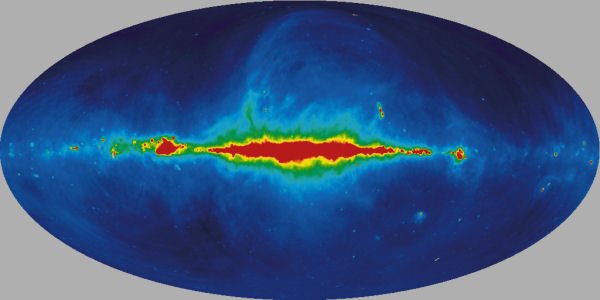
On the lower EME bands, 6m, 2m and 70cm, the effective sky temperature can be very high, this results in high levels of sky noise which in tern make it difficult to detect and decode weak signals. On 23cm much, but not quite all, of this background radio noise is absent.
Everywhere in the sky there is noise. This is the CMB or Cosmic Microwave Background. It's the red shifted radio noise from the "Big Bang" origin of our universe which appears to have happened about 14 billion years ago. There is also background noise mostly from galactic sources as in composed of noise from stars, gas clouds and other cosmic sources. This noise is mostly confined to the region of the sky where we see the Milky Way as in the sky map below.
Sky noise can be measured by noise temperature. It's essentially the equivalent temperature of a resistor that would produce the same amount of noise power as the antenna receives. The lowest sky noise temperature is in the region of 2.7K (2.7 degrees above absolute zero). An antenna acts as a noise source equal to the noise temperature of whatever it is pointing at. So pointing a perfect antenna at a 2.7K sky would results in a 2.7K antenna noise temperature. A perfect antenna would have no losses and no sidelobes, so this is obviously a theoretical situation! Similarly, an antenna point down to the ground on a day when the temperature was 0C (273K) would have a noise temperature of 273K. That's a difference of about 20dB. So if you had a perfect RX system with no losses and an LNA with a 0dB noise figure, you would see a ~20dB difference in noise power between the 2.7K sky and the 273K ground. Even with the worlds best antenna and the world's best cryogenic LNA, you won't see numbers this high. For a good EME system on 23cm you will probably be looking at something between 8dB and 9db "ground" noise, where "ground noise" is with the LNA looking at a 50 ohm load (through an isolation relay) at ambient temperature.
So what is the temperature of the coldest region in the sky at 1296MHz?
Cold sky temperature around 1300MHz is comprised of several components
- The Cosmic Microwave background = about 2.7k
- Galactic (with possibly some extra-galactic) continuum noise. This turns out via a number of methods to be around 1K
- Atmospheric noise cause by the tail of some molecular and atomic absorption in the atmosphere. This is variable and depends on weather and elevation, but it can be estimated to be around 1.5K
So we are looking at a sky temperature in coldest part of the northern sky, well away from the Milky Way of around 5.2K. This will rise as we move towards the Milky Way and are looking through the plane of the galactic disk, especially when looking towards the center of the galaxy. Here the sky temperature will depend on the antenna beamwidth because the "hot " area of the sky is quite small, so larger beamwidth see an average lower temperature. With a 3dB beamwidth of around 5 degrees (typical for a 3m class antenna at 1296MHz), the highest average sky temperature is probably of the order of 25K. With a 1 degree beamwidth, the sky in the direction of the center of the galaxy could look as hot as 100K at 1296MHz and over 2500K at 432MHz.
It seems that continuum galactic noise falls by a factor of (f1/f2)^(-2.8), where f1 is the higher frequency and f2 the lower. This would predict that continuum galactic noise at 1296MHz would only be around 4.5% of that seen at 432MHz. Skies are relatively quiet at 1296Mhz. The system RX noise floor is given by the sum of noise from many sources. One is the antenna temperature which is a combination of sky noise, ground noise due to any spillover and feedthrough and noise picked up by sidelobes which see the ground, then there is the LNA noise and the noise generated by losses in the connection between the LNA and antenna (usually an isolation relay, with associated cables and connectors. All of these can be expressed as noise temperatures.
On 23cm, an LNA might have a 0.25dB noise figure, which can be expressed as a noise temperature of around 17K. Losses between the input of the LNA and the antenna might be 0.05dB which converts to about 3K. For a typical mesh dish, feedthrough and spillover might and a noise contribution equal to something between 15K and 25K. So before we add the sky noise temperature we already probably have a noise temperature of something like 40K. If we take the coldest sky to be 3K, then we have a system noise temperature of around 43K. This system would then show about 8dB more noise when the antenna was pointed at the ground (at 0C) than it would from the sky.
When looking at the moon using an antenna with a beamwidth significantly larger then the moon (which is just about all antennas used by amateurs at 23cm), the antenna will mostly see noise from the sky. While the moon is also a noise source, it will usually occupy only a very small fraction of the antenna pattern. Even with a 10m dish, on 23cm the moon would only occupy about 10% of the 3dB beamwidth.
Below is a sky temperature map at 1420MHz showing only the Cosmic Microwave Background and the continuum noise (broadband noise), and it excludes the contribution for Hydrogen clouds (which is not see at 1296MHz) and any other discrete frequency sources. It should be a pretty good estimate of what would be seen by a 23cm EME station.
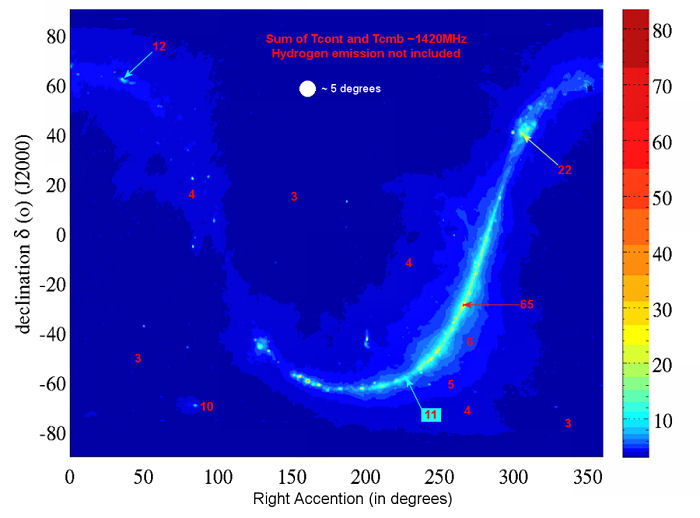
Above data from Astrophysical Journal. The white disk represents a 5 degree beamwith (~ 3db beamwidth of a 3m dish on 23cm)
The numbers represent the sky temperature in K. The "hottest" part of the sky is in the galactic plane which is defined optically by the Milky Way in the night sky. The moon's path crosses this region. At longer wavelengths the noise can be very high, but at 23cm it's generally pretty low. Over the vast majority of the sky it's less than 10K and in many regions it can be as low as 3 to 4K. This the sky is generally very quiet at 23cm. Only in a few regions, such as those found in the constellation of Cygnus (map top right) and Sagittarius does it rise into double digits, The hottest region is the direction of the galactic center. The moon does cross the Sagittarius region each month. This has a significant effect on 6m, 2m and 70cm operation, but not so much on 23cm. 23cm background noise can increase, by perhaps as much or 2 or 3dB for large dishes, so weak signal decoding will be affected. For small dishes with larger beamwidths the sky temperature rise is lower because the hotter regions do not fill the beam.
Atmospheric contribution
On the microwave bands (1Ghz and up), there can be a significant amount of noise which is generated due to atmospheric attenuation. At 23cm this is quite small, but at low elevation angles it can be significant, since at low angles the beam passes though a much greater length of atmosphere. Attenuation comes from the extended tail of a complex of oxygen absorption bands in the 50-70Ghz region, which show 10-15dB/km attenuation. At 23cm water vapor and rain have no significant absorption. This is not the case at higher frequencies, and in general the higher the frequency the higher the absorption. 24GHz is particularly badly affected by water varpor. On 23cm, the contribution of atmospheric attenuation to antenna temperature can be approximated using the plot below:
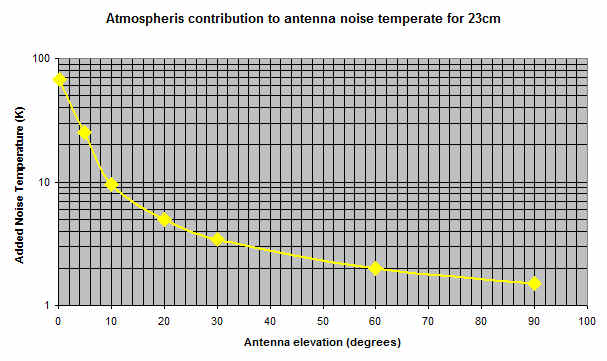
As you can see, at elevation angles above 30 degrees. the atmosphere can add about 2K to the antenna noise temperature. A good Rx system and a quiet antenna on 23cm probbaly has a recive noise temperature on the 40-45K range. In that case, adding 2K noise would result in about a 0.2dB loss in the SNR of a decode signal. At low elevation angles most antennas will also pick up more ground noise, further raising the noise floor.
Practical Experience
In my experience, at 23cm, most of the extraneous antenna noise over the CMP is in fact pickup of ground noise and other terrestrial signals by sidelobes, dish spillower and dish feedthrough (for mesh dishes). During the day sidelobes may also see some sun noise. I've found that the difference in cold sky between the Cassiopeia A region in the Milky way and the galactic pole region where the sky is very cold, is probably less than 0.1dB on my 3.1m and 1.8m dishes (which both have 8dB or better ground noise Y-factors). I'm pretty sure my coldest sky generally corresponds to an antenna position which minimizes side load pickup of terrestrial sources. Read cosmic sky noise noise makes a pretty small contribution to antenna temperature since even if there is a "hot spot" in the sky, it only occupies a small area of the sky that the antenna is seeing. Unless you have a large dish (6-10m or more) and the moon is right in front of the Sagittarius A* region (center of the galaxy), actual sky temperature at 23cm probably isn't something be worry about. Reducing side lobes and spillover, and improving LNA performance are all probably more important things to look at.
References
Here are some relevant documents. Remember that many measurements in the 1400MHz L-band region are looking for H1 (Hydrogen) emission at 1420.4MHz (+/- around 2MHz from Doppler shift) from hydrogen gas clouds associated with the galactic plane (Milky Way as seen from earth). That's the region of interest for radio astronomers. Some studies include this noise, but others do not. Sky noise at 1296 MHz should be very similar to that anywhere around 1400Mhz once hydrogen emission is removed from the measurement
* - Peak sky temperature as a function of beamwidth - NARO
* - Map of Sky background brightness temperature at L-band - NASA
* - An Absolute Measurement of the Cosmic Microwave Background Radiation Temperature at 20 Centimeters