.jpg)
The Solar Cooker dish - A low cost, lightweight, portable dish for 23cm to 3cm EME
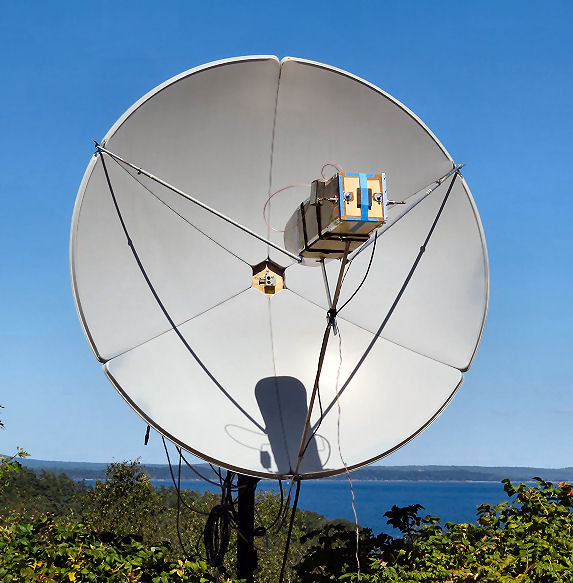
1.5m dish and feed for 23cm. Total cost ~ $100 (and a lot of work...)
Finding a dish for EME use is one of the most common (and difficult) tasks for those interested in the microwave bands from 23cm to 3cm (and up). Small commercial offset satellite dishes for Ku band operation are pretty easy to find. For about $100 you can find a 3ft (90cm) offset dish which will work OK at 10GHz, but it's a bit small. On any lower band it's very small, to the point of being pretty useless on 23cm. You can potentially find 1.2m offset-fed TV dishes, but now the price has risen to many $300 once you include shipping, because a one-piece 1.2m dish is too large to ship via normal UPS/FedEx/USPS shipping services, It has to ship as freight. 1.2m is better for 10GHz, though still on the small side and while it may not be useless at 23cm, it's getting pretty close to it!
So unless you can find a local surplus commercial dish in the size you want, your options are limited and things can get expensive.
How small can you go?
So what to do? Well, first, how small can you go and still have a usable dish for EME on 23cm and higher bands. I think the answer to that can be found by looking at what others have done, and the HB9Q DxPeditions have had great success with a 1.5m dish which they use on all bands from 23cm through 10Ghz. (and at power levels of 100W on 23cn to 50W on 3cm) Their dish was custom built (by a swiss ham, now SK I believe) and looks like a work of art! It's a mesh dish which can be taken apart for transport and has been used all over the worked.
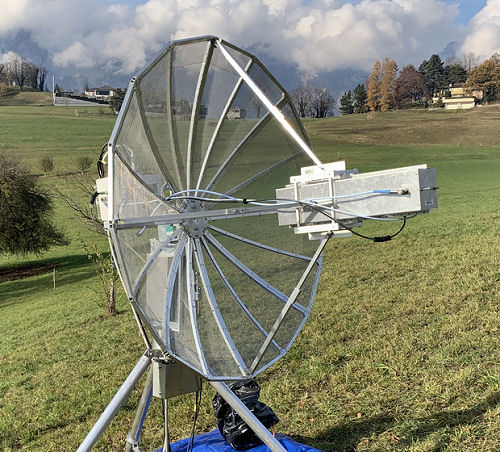
1.5m dish on 23cm operating as HB0/HB9DBM in Liechtenstein (100W at feed)
I've heard them on 10Ghz with a dish as small as 90cm and I've easily worked them on multiple occasions on 23cm (digital modes) with a 3m dish and 250W with good sigal strength So while 1.5m is pretty small, it's big enough (provided the rest of the system is of equal quality). The HB0/HB9DBM dxpedition in 2018 (when 23cm activity was lower than it is now, worked 58 different stations on 23cm with their 1.5m dish. In 2021 as SV5/HB9COG they made 81 23cm QSOs (running 50W) and 16 QSOs on 13cm (again running just 50W). On 3cm (with 50W) they made 28 QSOs. So there is no doubt at a good 1.5m dish with only 50W is capable of making a lot of QSOs on 23cm and 13cm and even on 3cm (if you have 50W there).
Attempting to duplicate their dish is probably an exercise in futility unless you are a Swiss watchmake or at least a professional machineist or mechanical engineer. It's certainly not something I would attempt to build from scratch. So where can you find a similar dish that's inexpensive, light, and, if possible, capable of being disassembled for transport if you wanted to ate it to a remote location.inexpensive
What Can you buy
If you are looking for a small dish, maybe for portable use, what's out there? The answer is not much!
For an off-the shelf system capable of portable operation, one choice might be the Sub-Lunar portable folding 2.4m dish. It's been used from a number of remote locations to successfully make contacts on 23cm (and maybe one of two on 13cm?). It's fairly light and folds to a small size. The product spec sheet states 8” x 8” x 66” and 15lbs. However it has a couple of issues. The first is it's not cheap. The second is that experience in the field has shown that the performance, even on 23cm, is not as good as you might expect from a 2.4m dish. However this is to be expected since the Sub-Lunar folding dish uses a stressed rib that only approximates a parabolic profile. The gain might reasonably be expected to be 1 to 2 dB lower than a perfect profile solid dish. While stressed dishes can get close to solid parabolic dish performance (see N2UO 20ft dish) this usually requires a shallow dish so that the ribs only need a slight bend. K2UYH (SK) also described several stressed dish designs. As originally conceived, the Sub-Lunar dish was seen as an alternative to the use of Yagi antennas for portable use. The ability to use circular rather than linear polarization with the dish immediately gives it a 2-3dB advantage and indeed, the portable 2.4m dish generally outperformed earlier Yagi systems used for portable work. Some of the performance issues may be due to the complexity of the original patch feed and hybrid coupler. There is now a lightweight septum feed which some have reported improves performance. It's commercially available and ALL the parts needed to make a system are also commercially available, so if you want a turnkey system, can afford it, and don't expect the performance you might get from a well profiled fixed 2.4m dish, it's a easy, convenient way to go.
A note on stressed dishes in general - According to web sources, the equation which defines the shape of the curve when a rod is fixed at one end and has a single point load at the other is a cubic equation, which means the defection curve is a cubic function of X, the distance along the rod. Its shape resembles a parabola but is not a true parabola, as a true parabola would be a second-order (quadratic) function. I believe that the smaller the bending, the closer it approximates a parabola, but I'm not a mechanical engineer.
RfHamDesign in the Netherlands has a series of fixed mesh dishes with excellent performance at 23cm (and on some higher bands). The 1.5m mesh dish kit is around $350 (plus shipping and import costs from the Netherlands). The kit is a set of parts which you have to assemble into a dish framework, then cut and install the (supplied) mesh surface. You can also buy everything from feeds to Az/El drives from them. I don't know how well this dish works on the higher bands, but you can buy it with mesh sized for 3cm operation. You can also get a 1.9m kit for around $420 (plus shipping, import, tariffs etc). This dish can be made to work well on 23cm. However, these dishes are portable only in the sense you could pick them up and carry them, but they are not designed to be taken apart once assembled(for example, they use rivets to secure the mesh to the ribs). So you might get one in the bad of a pickup truck, but you are unlikely to be able to take it with you on an aircraft or ship it to a remote destination.
But is there another alternative? If you are prepared to do some simple mechanical work needing nothing more than a saw, drill and screwdriver, is it possible to build something at low cost? Well, it turns out the answer is yes.
While casually wandering through the AlliExpress website (as I often do), I came across this:
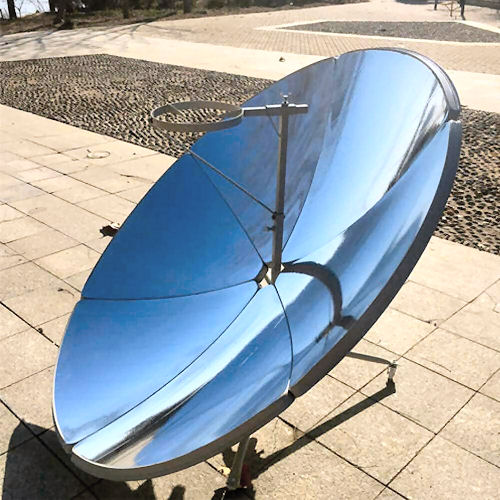
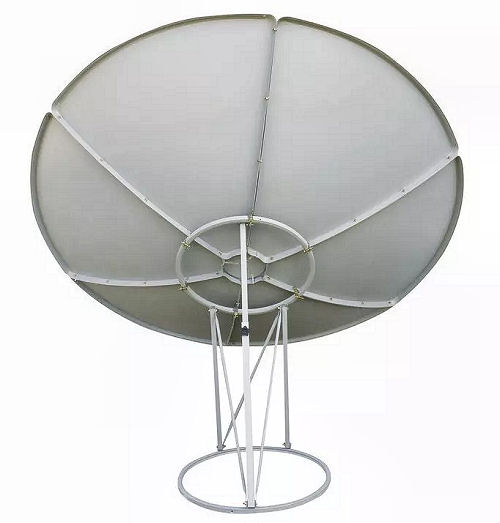
The Solar cooker dish
Well, it looks sort of parabolic (maybe) and it is intended to focus the sun (which would be best done with a parabolic mirror), but just because it sort of looks like a dish antenna doesn't mean it is one. However close inspection of a number of photographs from several vendors seemed to suggest the construction was very similar to that of a number of Chinese TV dishes, from 1.2m to 2.4m in diameter. They are said to be C-band dishes (4Ghz) and some also mention Ku-band use (12Ghz). When I say they look very similar, I mean pretty much identical as far as I could tell from the photographs. So I ordered one. I think I paid $52 at the time (April 2025) and that included shipping.
Sure enough, after waiting a little while, a smallish box shoed up. It was about 3ft x 3ft x 6" and it weighed around 35lbs. It was delivered by UPS (or maybe FedEx) on their regular truck. If it was an antenna inside, it was certainly in an easily transportable form.
Leaving out the exact assembly details (no instructions, but pretty obvious), I bolted the 6 panels (stamped out from thing sheet steel)together and mounted it on the enclosed "Az/El" mount (very limited El range). Quality looked like typical low end Chinese mechanical construction. The welding on the mount appeared to have been done by the Chinese school for visually impaired welders, with angles being a visual approximation of what they should be, but it all went together with a little encouragement.
It certainly worked as a solar "cooker" since holding a piece of wood at the focus resulted in it bursting into flames. To prevent accidents, like burning down the house, I removed the adhesive aluminized mylar tape which has been applied to the surface, leaving behind what looked like a normal powder coated grey TV dish surface.
So it looked like a parabolic TV dish, but was it? Well, I figured to best test would be to measure sun noise at 10Ghz. That's a tough test of surface accuracy and if it's good at 10Ghz, it's certainly good at all lower frequencies. Without doing into details, I determined that I could indeed see a significant level of sun noise, so that it was worth proceeding with an attempt to properly position the feed and mount the dish on a real motorized Az/El mount.
The versions of this dish actually sold as antennas rather than a solar furnace us a very simple way of attaching feed supports as shown below
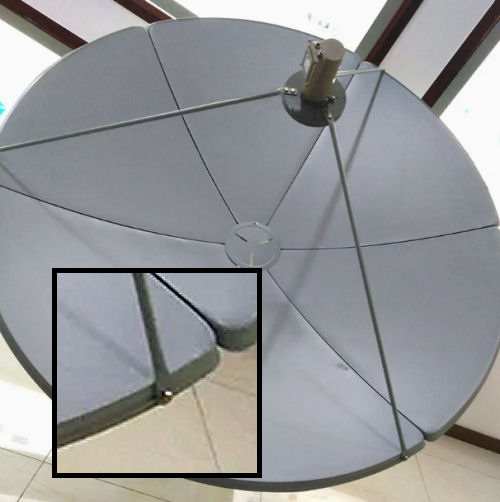
Adding feed support struts was quite easy and I will describe them later. The back of the solar cooker appears identical to that of the similar TV dishes in that there is a large ring attached to the folded over rims of the 6 dish segments as shown in the image below. These folded over edges of the segments act as "ribs".
Here are a couple of images showing how the feed support struts were mounted and how the dish was attached to my SPID BigRAS rotor system
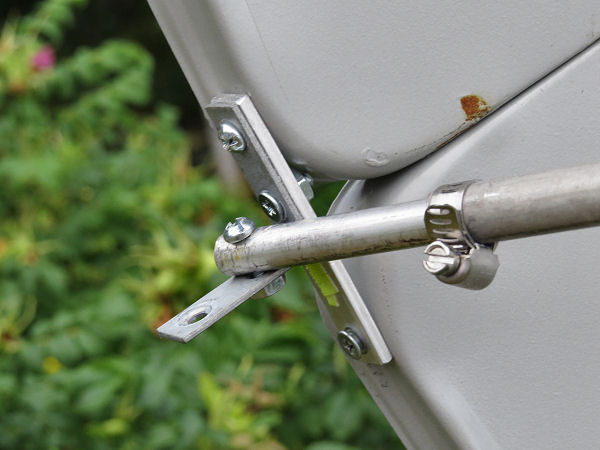
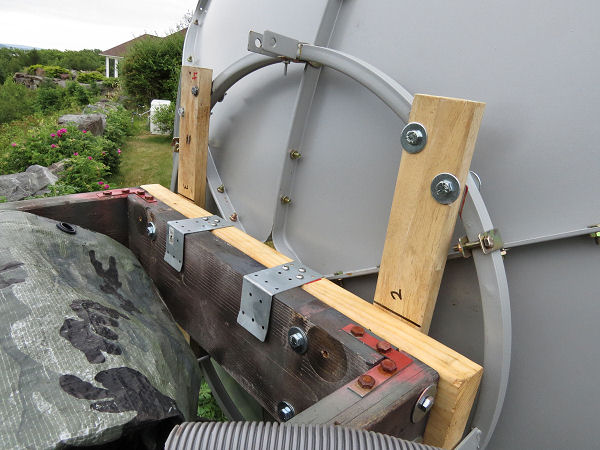
After centering a 10Ghz feed and determining the best position for it, which turned out to be about 22" from the dish making the f/d 0.38, I made a number of careful sun noise measurements. The result was a sun noise Y-factor reading of around 11dB. Earlier I had made the same measurement using the 1.2m dish (which is known to be good) and measured a sun noise Y-factor of around 9dB. The theoretical difference between a 1.2m dish and a 1.5m dish (all else being equal) should be 1.94dB, so the 2dB observed difference is right in line with what would be expected if the 1.5m dish had an accurate profile for 10Ghz. It then pretty much follows that the 1.5m dish will be accurately profiled for 6cm, 9cm, 13cm and 23cm and so can be used on any of those bands.
Preliminary testing of the Solar Cooker dish on 23cm
Initial testing was done on 23cm using a home made patch feed and a PCB fabricated branchline coupler. Neither of these was probably ideal. The PCB based brachline coupler as estimated loss in to 0.3dB region. Additionally there would be expected to be losses in the connecting lines (.141 semi rigid cable) and connectors. Sun noise was quite low (around 4-5dB) even with a good DDK LMA (NF of maybe 0.3dB). However, testing with several stations including KB2SA (1.9m dish and 800W), EME signals (30B) were easily visible and decoded without AP. KB2SA decoded at around -18dB, which Bill said was about the same as Bill usually received from 2.4m folding dishes. So far so good, but could it be better?
Further work on optimizing the feed and its position resulted in sun noise levels of around 7.5dB with the 10.7cm SFU at around 125. Further work may well improve this. Measurement of sun noise was done using a step attenuator as shown below.
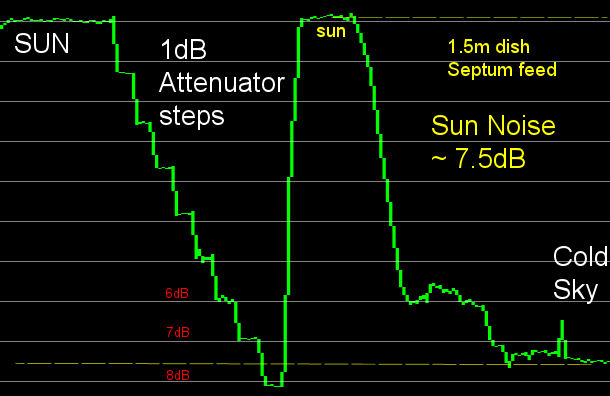
I am currently building two different lightweight septum feeds (based on OK1DFC septum dimensions) for use with this dish which should improve RX sensitivity. Initial tests with the first septum feed have shown about 7.5dB of sun noise (SFU ~120). This is quite reasonable. Decoded signal strengths are pretty much in line with what would be expected for a 1.5m dish and septum feed. The septum feed (no choke) probably over-illuminates the dish, resulting in slighly lower then ideal sun noise due to spillover. Feed weight is about 1kg. It's based on a copper foil covered wooden structure and has a stepped septum. I will publish details after further testing and optimization. Since wood may not be the best material for an outdoor structure (though it works well for sheds and boats!), I'm also working on an all aluminum designs which can easily be built at home without requiring bending or welding.
Bottom line
Quite surprisingly, the 1.5m "Solar Cooker" makes a good parabolic microwave dish antenna and a price considerably lower then similar dishes sold as TV dishes. The only real practical difference is that you need to make 3 feed support struts, not a difficult task. I suspect that somewhere in China a factory is stamping out the dish panels for a few dollars each. Some go to antennas. Some good to solar cookers, which being "low tech" items sell for a lower premium than "high tech" satellite dishes. My "solar Cooker" cost $52, but that was in the pre-tariff days. I see then on sites like Alliexpress and even on Amazon at prices starting around $75 at the moment, so they are still cheap. I see similar TV dishes selling for around $250 for a 4f (1.2) dish, 1.65m dishes selling for around $750 and 2.4m dishes selling for $850. There's no guarantee the 2.4m dish will hold profile for 10Ghz, though it might. The 2.4m version weighs around 100lbs and would be difficult to ship (too big for UPS/FedEx.
One factor which makes the 1.5m solar cooker dish easier to work with then some other systems, is that it appears that the dish itself is very well profiled and being solid, there's no chance of feed-through. This means that if you are not getting the performance you might expect from a dish of this size, it's not the dish's fault so you don't need to spend any time on effort on that part of the system. You can concentrate your efforts on the feed and the LNA.
Initial assembly of the 1.5m dish took about an hour. It's just a matter of aligning the segments and bolting them together, then "persuading" the rear ring to fit into the brackets on the ribs. Maybe add another 30 minutes for installing and adjusting the feed support structure. Weight is around 30lbs. Maybe 35lbs with a feed. It's an easy one-person lift. When taken fully apart the dish panels will fit in a box thats 3ft square and 6" deep, so it's "transportable" in that it can be mailed by UPS/FedEx, carried in a car trunk or even shipped as luggage when flying. It could be quickly broken in half to be 1.5m x 0.75m and carried in a car. It could probably be carried on the roof of a car without being taken apart as it's only 5ft wide. That's less than the width of even smaller compact cars.
The solar cooker dish appears strong enough to withstand significant winds, not affected by rain, and is profile is accurate enough to give excellent performance on all bands up to 10Ghz. Theoretical gain would be 4dB down on an equally well profiled 2.4m dish with no feedthrough. The Chinese "specs" on very simar looking TV dishes suggest max. wind speed for operation is about 55MPH and claim no damage it 145MPH (if it stays on the ground....), but remember these are Chinese specs and are probably somewhat over-optimistic.
If you don't want a transportable dish, the solar cooker dish makes a pretty decent 1.5m prime focus dish (f/d 0.38) for 10Ghz use, or at least mine seems to work well there. For maybe $75 plus around $25 in plumbing parts from the hardware store and a few hours labor, It's not a bad deal. Just like any other antenna, you have to have an Az/El mount and controller and figure out some way to mount the dish on it of course.
Links